
A Professional Office Setup Without the Heavy Overhead
A startup rarely needs the same kind of office setup as an established company with several departments. Early teams often need flexibility, a professional setting, and enough room to work comfortably without committing to more space than they can use. A Co Working Space can offer that balance by providing furnished work areas, meeting rooms, reliable internet, and shared facilities within one organized environment. For a small business, that can remove many of the costs and decisions involved in setting up a traditional office. It also allows the team to focus more attention on clients, projects, and growth rather than spending time managing furniture, utilities, maintenance, and other workplace details.
One of the biggest advantages is access to facilities that might otherwise be expensive to create privately. A small team may need a conference room only a few times a week, but leasing a larger office just to have one permanently can be difficult to justify. Shared meeting rooms, kitchens, lounges, and phone booths solve that problem by making useful spaces available when they are needed. This gives startups a more polished environment for presentations, interviews, and client meetings without requiring them to carry the full cost of every amenity. It can also make the workplace feel more complete from the first day.
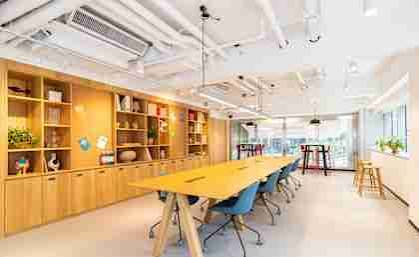
Flexibility becomes even more valuable as staffing changes. Startups often grow in stages, and headcount can shift quickly when new projects begin or funding priorities change. A business that starts with two or three people may need room for six a few months later. Flexible offices can make those transitions easier by offering different workspace sizes under one roof. Instead of relocating every time the team changes, a company may be able to move into a larger private office or add desks as needed. That can reduce disruption and make expansion feel far more manageable.
Predictable costs are another practical benefit. Traditional offices can involve separate bills for furniture, internet, cleaning, utilities, maintenance, and meeting-room equipment. Those expenses can be difficult to estimate when a business is still finding its rhythm. Flexible workspace arrangements often combine several of these essentials into one agreement, which can simplify budgeting. The goal is not necessarily to find the lowest possible rent, but to understand what the business is receiving for the money. When essential services and shared amenities are already included, smaller teams can make clearer decisions about how much workspace they truly need.
For young companies, a professional workplace should support growth without becoming a financial burden. Choosing a Co Working Space can provide a useful middle ground between working from home and taking on a long-term traditional lease. Teams can meet clients in a credible setting, use shared facilities, and adjust their footprint as the business develops. That combination of presentation, convenience, and scalability can be especially helpful when every expense still matters. With the right setup, a startup can create a workplace that feels established and capable while keeping enough flexibility to respond to new hires, changing projects, and the opportunities that often arrive faster than expected.